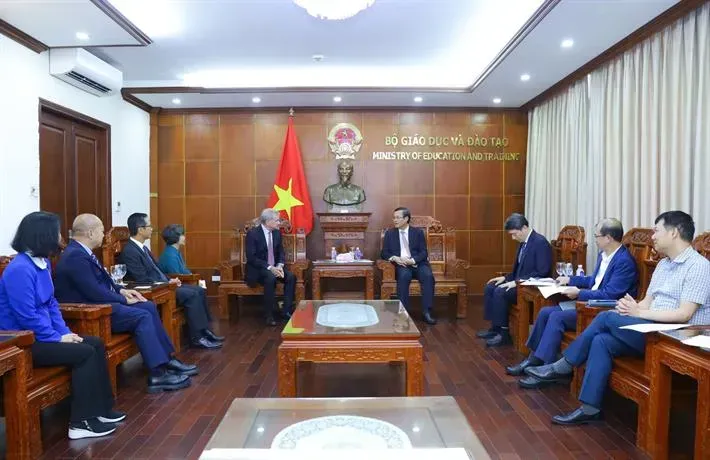
On June 10, at the Ministry of Education and Training (MOET), Deputy Minister Nguyen Van Phuc welcomed and held discussions with Mr. Alex Rogers, Chairman of Qualcomm Technology Licensing (QTL) and Global Governance Officer of Qualcomm Corporation.
Expressing his gratitude to the Deputy Minister for the meeting, Mr. Rogers stated that he hopes to understand the key focus areas through this discussion and contribute further to the development of education in Vietnam in the coming period.
According to Mr. Rogers, the areas Qualcomm aims to cooperate with the Vietnamese MOET include:
- Implementing collaborative activities with universities and developing AI technology human resources in Vietnam;
- Promoting the Qualcomm Vietnam Innovation Challenge (QVIC) program to support and develop the startup ecosystem in Vietnam;
- Discussing the potential for AI training programs and other technologies where Qualcomm has expertise.
Based on Mr. Rogers’ proposals and Vietnam’s requirements for high-tech human resource training, Deputy Minister Nguyen Van Phuc outlined six areas for cooperation with Qualcomm:
- Joint Training Programs: Both sides will collaborate to implement AI, 5G, and IoT (Internet of Things) training programs for Vietnamese universities, with Qualcomm engineers participating as instructors.
- Internship and Laboratory Support: Qualcomm is requested to support Vietnamese students to intern at Qualcomm laboratories to gain exposure to advanced global technologies. Qualcomm will also assist in establishing an AI laboratory at Hanoi University of Science and Technology or another university meeting Qualcomm standards.
- Faculty Development: Currently, Vietnam’s teaching staff in semiconductor training is very limited. Therefore, Vietnam hopes to send lecturers abroad for training, host foreign experts for teaching, or leverage Qualcomm’s existing teaching resources.
- Startup and Ecosystem Development: Promote technology startup competitions and develop the tech ecosystem by incubating creative enterprises in 5G, IoT, AI, smart cities, wearable devices, and multimedia using Qualcomm platforms.
- Supporting National Human Resource Projects: Qualcomm will accompany and support MOET in implementing the objectives of Project 1002/QĐ-TTg, aimed at building a high-quality workforce in high-tech fields to meet the country’s socio-economic development needs.
- Ordered Training and Funding Cooperation: Both parties will cooperate in commissioned training for AI and high-tech human resources, utilizing ODA funding sources if available.
Deputy Minister Nguyen Van Phuc also noted that the Vietnamese Prime Minister recently issued a strategy for semiconductor training, aiming to train 50,000 engineers in the field by 2030. Regarding AI, Vietnamese universities are also opening programs with the goal of training a large number of engineers.
He emphasized that with over 2.2 million students, one-third of whom are studying STEM fields, Vietnam is keen to absorb cutting-edge scientific and technological knowledge from around the world.
“Vietnamese students lead the region in mathematics, which is an advantage in transforming mathematical ability into research capacity in AI and semiconductors. MOET is ready to connect Qualcomm with Vietnamese universities to provide advanced training in these areas,” Deputy Minister Nguyen Van Phuc shared.
Media and Events Center